
PHP2Shell: The MSP Response Playbook (and Why It's Only the First Wave)
By · October 23, 2026
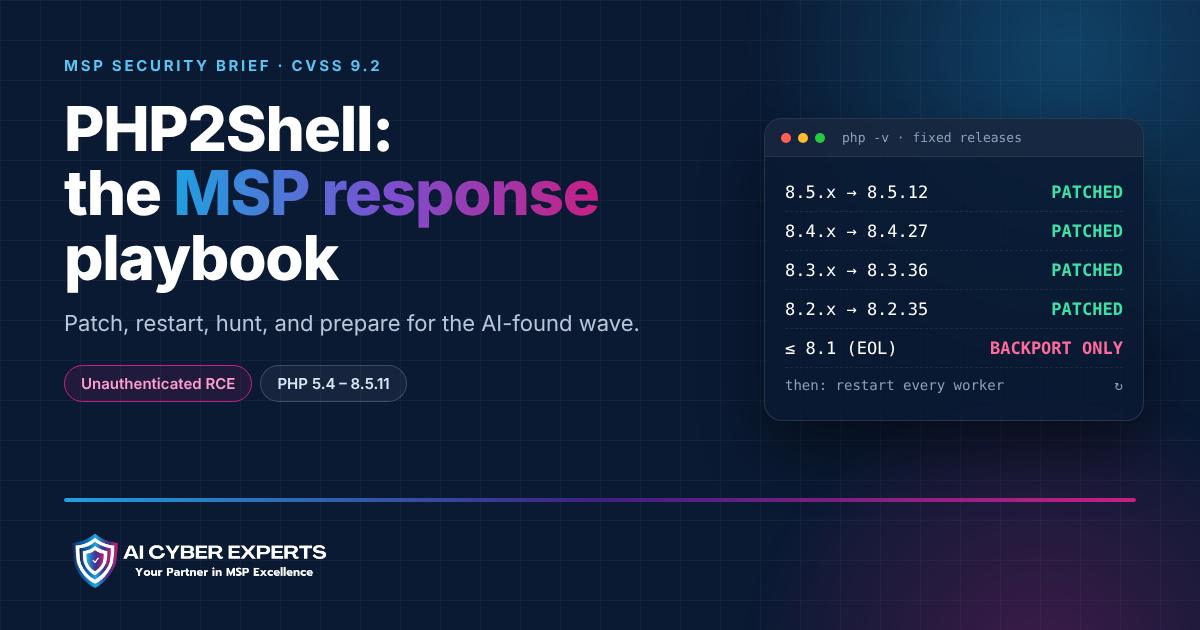
On 21 October 2026, PHP shipped emergency fixes for PHP2Shell: two critical flaws that let an unauthenticated attacker run code on a web server before any application or login runs. Every PHP release from 5.4 to 8.5.11 is affected. If your clients have websites, portals, WordPress, or any line-of-business web app, you have exposure. This is the response plan we'd run across a client base this week, followed by the bigger lesson: PHP2Shell is only the first wave of memory-corruption exploitation going mainstream.
What PHP2Shell actually is
PHP2Shell is the name researchers have given to a pair of vulnerabilities in the PHP runtime itself, not in any one application. Both bugs sit in how PHP handles CGI and FastCGI requests. A crafted request reaches the PHP binary directly, corrupts memory, and executes attacker-controlled code in the context of the web server user. No login, no upload form, no plugin. The web server itself is the target.
- Affected: PHP 5.4 through 8.5.11, running as CGI or FastCGI behind Apache or nginx. That covers most shared hosting stacks and a large share of self-hosted WordPress and Laravel deployments.
- Not affected: PHP running under php-fpm with a correctly locked-down document root and no direct CGI handoff, and PHP inside containerized runtimes that never expose the CGI binary.
- Impact: unauthenticated remote code execution. Attackers can plant web shells, pivot into databases, and harvest credentials without ever triggering an application-level alarm.
Why this hits MSPs harder than a single breach
When a runtime-level RCE lands, you don't have one compromised client. You have every client whose hosting stack matches the vulnerable pattern. A single exploit sweep across an IP range can compromise dozens of customer sites in hours. That turns one CVE into an MRR event: emergency response work, rebuilds, client calls, and the awkward conversation about why patching was behind schedule.
The economics matter too. Emergency response on a runtime exploit is more expensive than routine patching: the fix ships at the runtime level, so you must touch every host, not every application. And because exploitation can begin before authentication, your usual "who logged in" forensics show nothing.
The 48-hour response plan
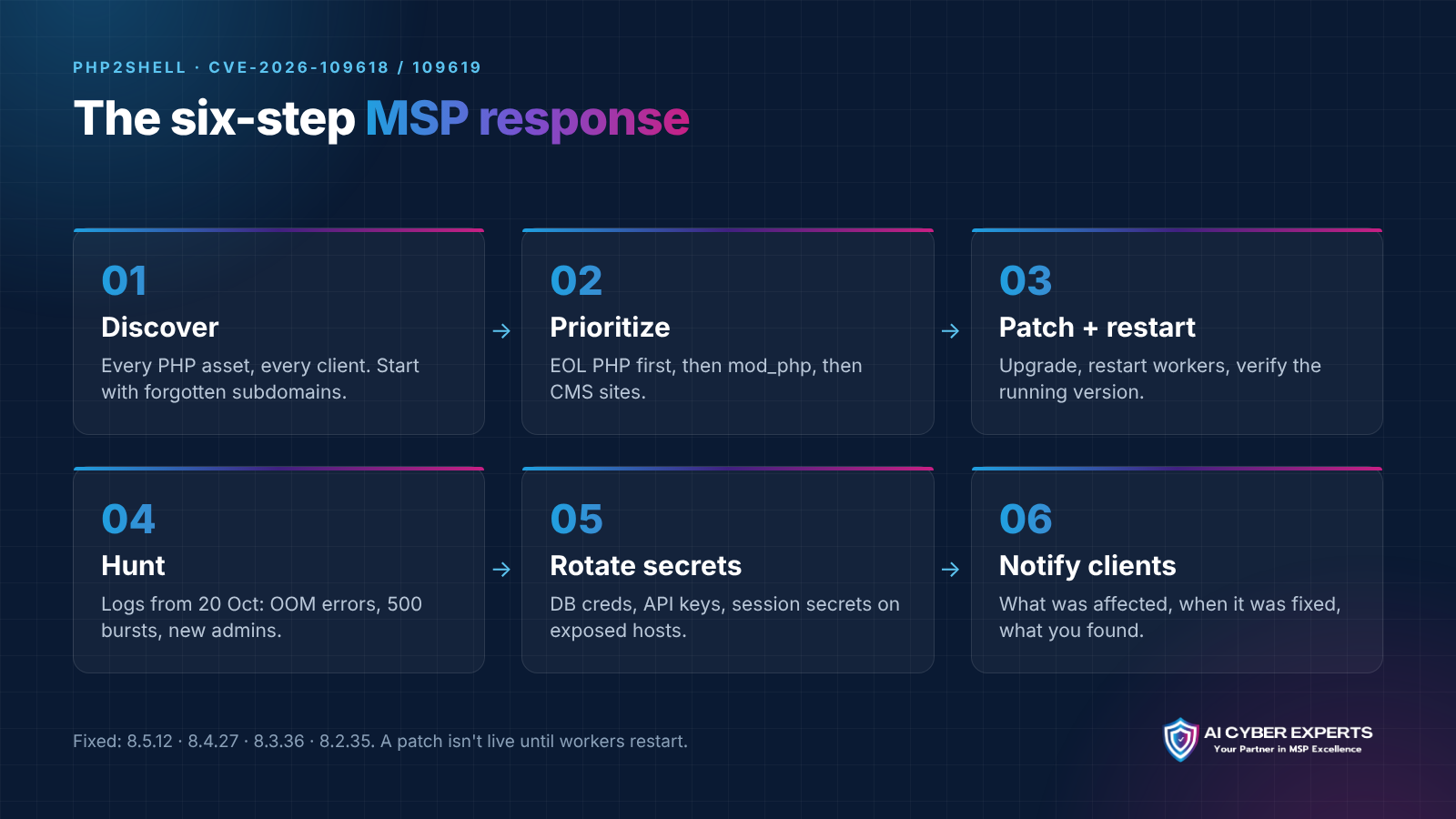
Hour 0 to 4: identify exposure. Inventory every PHP endpoint you manage, hosted or self-hosted. Flag anything running PHP as CGI or FastCGI. Shared hosting panels (cPanel, Plesk) usually expose this directly. Don't trust the client's "we're on fpm" answer; verify from the config.
Hour 4 to 12: patch or mitigate. Deploy the PHP updates to the highest-risk hosts first: anything internet-facing, anything handling logins or payments. If you cannot patch immediately, mitigate: disable CGI handoff, block the crafted request signatures at the web application firewall, or move the workload to php-fpm with a locked document root.
Hour 12 to 24: hunt. Search web server logs for the request patterns associated with the exploit: unusual query strings hitting the PHP binary directly, POSTs to .php URLs with malformed parameters, and spikes in 500 errors followed by outbound connections. Look for new files in web-writable directories: web shells arrive minutes after successful exploitation.
Hour 24 to 48: verify and report. Confirm every flagged host received the patch. Re-run log hunts after patching to catch pre-patch compromise. Send the client a two-paragraph summary: what happened, what you did, what they should watch for.
What to tell clients
Clients will hear about PHP2Shell from trade press or a competitor. Get ahead of it. The message that works: "A new PHP vulnerability affects web servers. We've already checked your stack, patched what needs patching, and verified no signs of compromise." That's it. No jargon, no CVE number unless they ask, no "we're still investigating." Confidence comes from having done the work, not from promising it.
If a client was exposed and compromised, the script changes: incident call within 24 hours, written timeline within 72, and a remediation plan that names what you'll change so it doesn't recur.
Why PHP2Shell is only the first wave
Three trends make this a pattern rather than an event.
First, memory-corruption exploitation is going mainstream. Attack tooling that once required nation-state budgets now circulates in criminal forums. Runtime RCEs that would have sat unexploited for months now get weaponized in days.
Second, hosting stacks are more uniform than ever. When most MSPs manage clients on the same three hosting panels, one exploit sweeps everyone at once. Uniformity is efficiency for defenders and attackers alike.
Third, AI accelerates both sides. Attackers use it to find and weaponize vulnerabilities faster. Defenders who use it well compress detection and response from days to hours. The MSPs that win the next two years won't be the ones with the biggest stack; they'll be the ones with the fastest loop from alert to verified fix.
The structural fix: MDR and patch discipline
PHP2Shell punishes two gaps: no runtime patch discipline, and no managed detection and response watching for post-exploit behavior. Patching alone leaves you blind between disclosure and deployment. MDR alone leaves you patching forever without closing the hole. You need both, and you need them delivered as a service your clients can see.
If you're an MSP without 24/7 eyes on your clients' web servers, this is the event that justifies adding it. If you have it, this is the event that proves its value to your clients. Either way, the next runtime RCE is coming, and the response clock starts when it drops, not when you read about it.
Need a white-label SOC and MDR layer you can sell under your own brand? Talk to AI Cyber Experts about 24/7 monitoring, runtime patch support, and response playbooks built for MSPs.